



Vault Standards in 2026: The Interface Is Settled. Control Is Not
In 2026, calling a product an ERC-4626 vault says less about how it is managed than many investors assume.
The interface has become familiar: deposit an asset, receive shares, redeem those shares later. But the market built above it has moved in several directions. Some vaults allocate among strategies in the same transaction. Others queue redemptions while an off-chain asset settles. Some accept several currencies into one balance sheet. And the most consequential differences now sit outside the token standard: who selects markets, which limits bind them, how quickly rules can change and what happens when liquidity disappears.
That distinction matters because vault standards are no longer a single-specification story. ERC-4626, ERC-7540 and ERC-7575 are all Final Ethereum standards. Together they cover synchronous, asynchronous and multi-asset structures. They make vaults easier to integrate; they do not make every vault equivalent.
The Vault Standard Is Now a Family
ERC-4626 standardised a common language for a vault with one underlying ERC-20 asset and one share token. ERC-7540 retained that foundation but added requests for deposits and redemptions that cannot settle immediately. ERC-7575 separated the vault entry point from the share token so several asset-specific vaults can issue the same share.
These are complementary answers to three operational questions: can the asset move now, must settlement wait, and can more than one asset lead to the same economic claim?
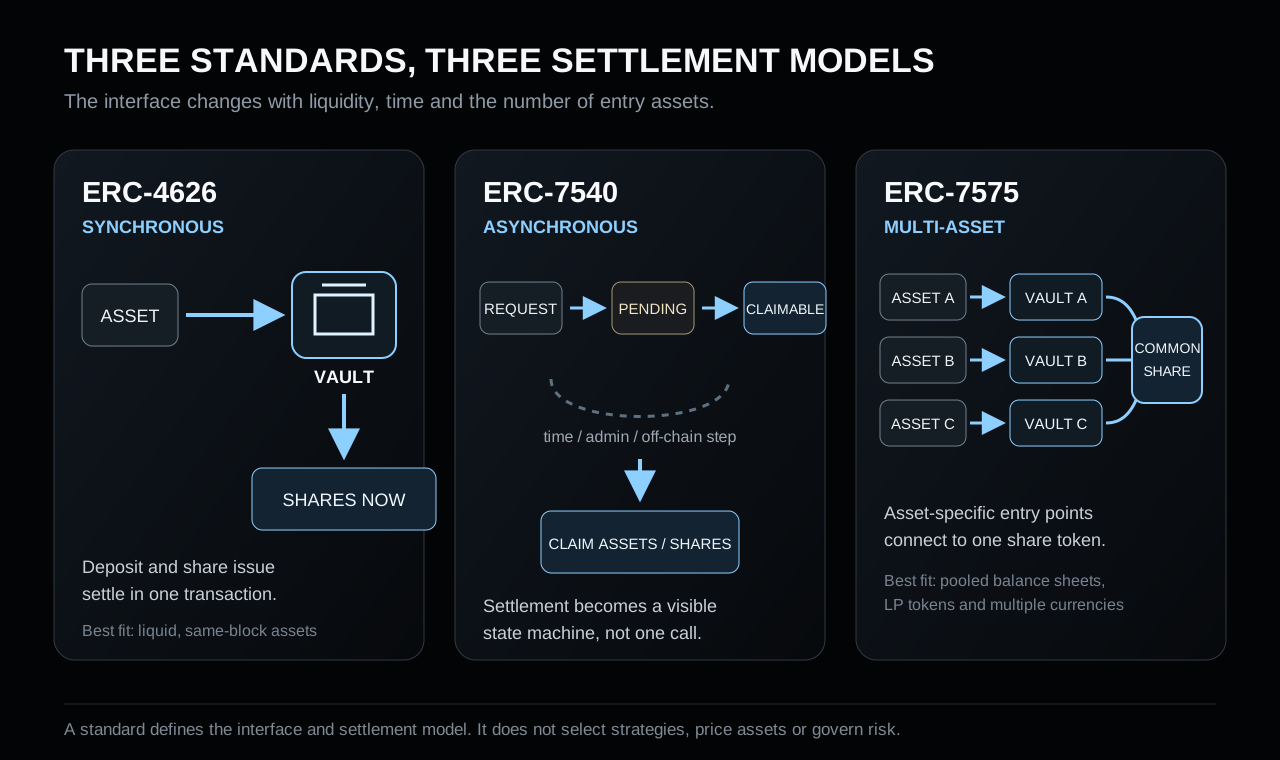
The distinction became more practical in July 2026, when OpenZeppelin released a modular ERC-7540 implementation. Its components allow a developer to combine synchronous, delayed or administrator-fulfilled flows on either side of a vault. That reduces the need to invent a new subscription and redemption state machine for every tokenized fund.
ERC-4626 Won the Interface Layer
ERC-4626 remains the default starting point. It defines how assets turn into shares, how shares convert back into assets, and how integrators can preview or limit deposits and withdrawals. Wallets, routers and lending markets can speak to many vaults through the same functions instead of maintaining a bespoke adapter for every yield-bearing token.
Advantages. The interface is compact, widely implemented and compatible with standard ERC-20 tooling. Atomic settlement makes the user experience legible: a successful transaction moves the asset and delivers the share. Its composability is the reason Yearn strategies, Morpho vaults, Euler markets and many lending or staking wrappers can appear similar to an integrator even when their internal economics differ.
Trade-offs. ERC-4626 assumes that deposits and withdrawals can complete synchronously up to the vault’s current limits. That is a poor match for private credit, tokenized funds, unbonding periods or cross-chain positions that need time. The standard also leaves allocation logic intentionally unspecified. A compliant vault may contain one simple lending position or a chain of strategies, price feeds and privileged roles.
Compliance is not a security certificate. The specification warns that a malicious contract can conform to the interface while still putting deposits at risk. Implementations must also defend share accounting against rounding and first-depositor manipulation. OpenZeppelin’s ERC-4626 guidance, for example, uses virtual assets and shares plus a decimal offset to make inflation attacks uneconomic.
ERC-7540 Gives Slow Assets an Honest Clock
ERC-7540 addresses the fiction that every asset can settle at smart-contract speed. A user first submits a deposit or redemption request. The request becomes pending, then claimable after a manager, time delay or external process fulfils it. Only then does the user call the familiar ERC-4626 function to receive shares or assets.
Advantages. The request lifecycle maps naturally to fund subscriptions, redemption windows, compliance checks, staking exits and assets priced at intervals. It also makes waiting explicit and machine-readable. A custodian or operator can act on behalf of an investor through defined permissions rather than a protocol-specific workaround.
Trade-offs. More states create more failure modes. The final exchange rate may not be known when a request is submitted. Assets or shares can remain pending, and cancellation behaviour is implementation-specific. The standard itself notes that request data can become stale and that an approved operator may control both vault assets and shares. An allocator therefore has to examine fulfilment authority, ordering, cancellation, valuation and recovery, not merely the ERC number.
Adoption is no longer theoretical. OpenZeppelin reported that Centrifuge was operating ERC-7540 vaults across more than $1.6 billion of real-world-asset pools when its implementation launched, alongside deployments from several institutional-facing protocols. The number is an adoption signal, not evidence that asynchronous structures are safer than synchronous ones.
ERC-7575 Separates the Asset Door from the Share
ERC-7575 solves a different constraint. In ERC-4626, the vault contract is normally also the ERC-20 share token and points to one underlying asset. ERC-7575 permits separate entry vaults for different assets to reference one external share token. A dollar fund could, for example, have distinct USDC and EURC entry points while preserving one economic share, subject to its conversion and accounting design.
Advantages. The model can reduce fragmented share liquidity, support pooled balance sheets and make asset-specific deposit rules easier to isolate. It is useful for LP positions, multi-currency products and systems in which custody, entry logic and share accounting need separate contracts.
Trade-offs. The separation is more demanding for integrators. ERC-7575 is not fully ERC-4626 compatible because the entry vault may no longer implement the ERC-20 share functions itself. Approval and redemption flows need additional care when the owner, caller, vault and share contract differ. Multi-asset accounting also introduces valuation and cross-subsidy questions that the interface does not answer.
Four Protocols, Four Control Models
The standards become easier to evaluate when separated from the protocols that use them. Four prominent architectures illustrate where competitive differentiation has moved.
| Protocol | Core vault model | How capital is managed | Principal strength | Principal trade-off |
|---|---|---|---|---|
| Yearn V3 | ERC-4626 allocator vaults plus independent strategies | Roles, accountants, debt allocators, strategy limits and withdrawal queues | Flexible strategy engineering and a mature vault lineage | Safety and liquidity depend heavily on strategy and periphery choices |
| Morpho Vaults V2 | ERC-4626 vault with protocol adapters | Curator defines adapters and caps; Allocators move capital; Sentinel can reduce risk | Granular caps, per-function timelocks and irreversible abdication | Curator, adapter and market dependencies require layered diligence |
| Euler EVK / Earn | ERC-4626 lending vaults composed under an aggregation vault | Governors configure markets; Earn roles manage strategies, caps and queues | Vault-to-vault composability across lending and allocation | Oracle, collateral, queue and nested-strategy risk can compound |
| Centrifuge | ERC-4626, ERC-7540 and ERC-7575 across pooled funds | Hub-coordinated requests, synchronous entry options and multi-asset share structures | Matches fund settlement and multi-currency operating needs | More operational state, administrators and off-chain dependencies |
Yearn V3 treats strategies as independent contracts and the vault as an allocator with accounting and debt controls. Morpho Vaults V2 makes governance policy unusually explicit: adapters and cap increases can be timelocked by function, while risk-reducing cap cuts can happen immediately and selected powers can be permanently abdicated.
Euler uses ERC-4626 twice: an EVK vault is a configurable lending market, while EulerEarn can allocate one deposited asset among approved ERC-4626 strategies. Centrifuge spans all three standards, using asynchronous requests for fund-like settlement and ERC-7575 when multiple investment assets lead to one share token.
None is universally superior. Each places complexity in a different location: strategy contracts, curator policy, connected lending markets or the settlement process.
Popularity Is Real, but the Numbers Are Not Comparable
ERC-4626 has the broadest integration footprint. The Tokenized Vault Foundation says the three standards it stewards collectively sit behind more than $13 billion in total value locked, but it does not apportion that figure by standard. ERC-7540 has a smaller yet increasingly visible production footprint in tokenized funds. ERC-7575 remains the most specialised of the three.
Protocol TVL offers another signal, provided it is not mistaken for a clean league table. A 17 September 2026 DefiLlama snapshot put Morpho Blue near $10.2 billion, Centrifuge near $1.5 billion, Euler V2 near $353 million and Yearn combined near $253 million.
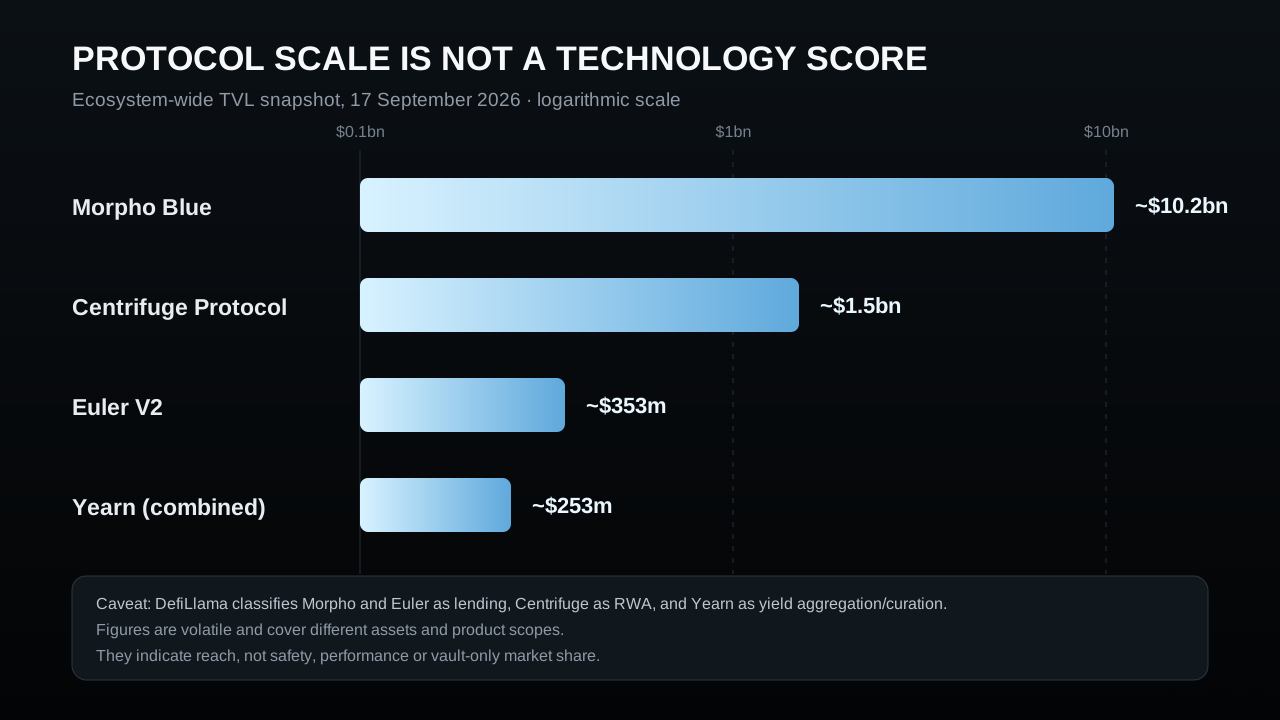
Morpho’s figure includes its broader lending primitive, not only managed vaults. Centrifuge measures tokenized assets, Euler includes lending markets, and Yearn aggregates several product lines. The honest conclusion is about reach, not quality: the vault interface has scaled across several business models, while capital concentration reflects distribution, incentives and market fit as much as technical design.
The Trade-Off Is Moving from Code to Governance
Once accounting becomes standardised, the important questions move upward. Who can add an adapter? Who decides that an oracle is acceptable? Can an allocator fill a concentration cap instantly? How long does a depositor have to react to a risk increase? Can an emergency role reduce exposure without gaining permission to introduce a new one?
Morpho V2 answers with granular caps, separate roles and action-specific timelocks. Yearn exposes configurable roles, strategy debt and accounting components. Euler distinguishes vault governors from Earn curators and allocators. Centrifuge must coordinate request fulfilment with fund administration and a multi-chain balance sheet. These mechanisms are not implementation details. They define the actual delegation boundary.
This is particularly important for automated or agent-assisted capital management. An adaptive system can monitor rates, liquidity and portfolio drift, then propose or execute a rebalance. The vault should still enforce eligible adapters, exposure limits, price requirements, timelocks and emergency conditions deterministically. A standard share interface makes the position legible; policy decides whether an action is admissible. The two should not be confused.
How to Choose a Vault Architecture in 2026
Start with settlement reality. If the underlying asset is liquid and can enter or exit atomically, ERC-4626 remains the simplest and most interoperable choice. If subscriptions, redemptions or unbonding need time, ERC-7540 represents that delay more honestly. If several assets must produce one share, ERC-7575 provides a clearer structure than pretending each entry token is a separate fund.
Then evaluate the protocol above the standard:
- Asset and valuation: what does a share represent, when is NAV updated, and which prices can be manipulated or become stale?
- Liquidity: is value merely reported by
totalAssets(), or can it actually be withdrawn through the current queue? - Authority: which owners, curators, allocators, operators and emergency roles can move capital or change rules?
- Boundaries: are adapters, markets, collateral, oracles and concentration limits enforced on-chain?
- Change control: which actions are delayed, immediately risk-reducing, upgradeable or permanently disabled?
- Failure handling: can requests be cancelled, strategies be unwound, losses be recognised and users exit without privileged cooperation?
The winning standard is therefore not one number. ERC-4626 is the common accounting language; ERC-7540 adds time; ERC-7575 adds multiple asset doors. The durable vault is the one whose settlement model matches its assets and whose control system makes every important authority visible, limited and testable.
That is the larger shift from the earlier era of ERC-4626 adoption. In 2026, interoperability is the entry requirement. Governance, liquidity and enforceable policy determine what the vault is actually worth.
Sources and Further Reading
- ERC-4626: Tokenized Vaults.
- ERC-7540: Asynchronous ERC-4626 Tokenized Vaults.
- ERC-7575: Multi-Asset ERC-4626 Vaults.
- OpenZeppelin and the Tokenized Vault Foundation: ERC-7540 implementation, 23 July 2026.
- Morpho Vaults V2 roles and capabilities; EulerEarn architecture and risks; and Centrifuge vault standards.
This article is for informational purposes only and does not constitute investment, legal or financial advice.