





Tokenized Funds Have Distribution. Now They Need an Operating Layer
For years, tokenization was discussed mainly as a new way to issue an asset. This week, it began to look more like a distribution system.
On September 16, DTCC announced that Ondo Finance’s regulated subsidiary had become the first tokenization platform to join Fund/SERV, the transaction-processing network that serves more than 85% of US mutual fund activity. The connection does not put every fund on a public blockchain overnight. It does something more consequential: it gives tokenized investment products a standardized route into the operational machinery already used by fund companies, wealth platforms and distributors.
Two days earlier, the UK Financial Conduct Authority published feedback from its wholesale-market tokenization consultation. Respondents identified post-trade processes, particularly the movement of collateral, as the clearest near-term opportunity. The FCA also pointed to its new framework for moving fund tokenization from experimentation toward wider adoption. Taken together, the developments mark a shift in emphasis. The industry is no longer asking only whether an asset can be represented on a ledger. It is asking how that asset connects to distribution, settlement, reporting, liquidity and portfolio operations.
Tokenization Has Crossed an Important Line
A token can represent a share in a fund, a Treasury claim, a deposit, a bond or another financial right. But the digital representation is only one component of a functioning market. Investors still need legally defined ownership, reliable records, custody, pricing, transfer controls, redemption and access to liquidity. Asset managers still need reconciliation, reporting and risk oversight.
The recent infrastructure announcements matter because they connect the new representation to those familiar functions. DTCC’s Fund/SERV connection covers account-level data, confirmations, reconciliation, distributions, tax reporting and regulatory reporting. In the UK, the FCA’s September feedback statement describes tokenization as a potential change to wholesale markets measured in decades, while keeping the focus on safe adoption and operational outcomes.
This is the point at which tokenization begins to compete on market structure rather than novelty. A digital wrapper is not enough. The asset has to work inside the systems through which capital is actually allocated.
Distribution Is Not Portfolio Management
Once more assets become available on programmable rails, a second problem becomes visible: who continuously decides what belongs in the portfolio?
A professional allocator does not compare instruments on yield alone. It considers duration, redemption terms, issuer exposure, liquidity, price reliability, custody, collateral eligibility, correlation, settlement timing and the venues through which a position can be entered or exited. Tokenization can make parts of that information easier to access and actions easier to automate. It can also increase the number of instruments and operating environments that must be evaluated.
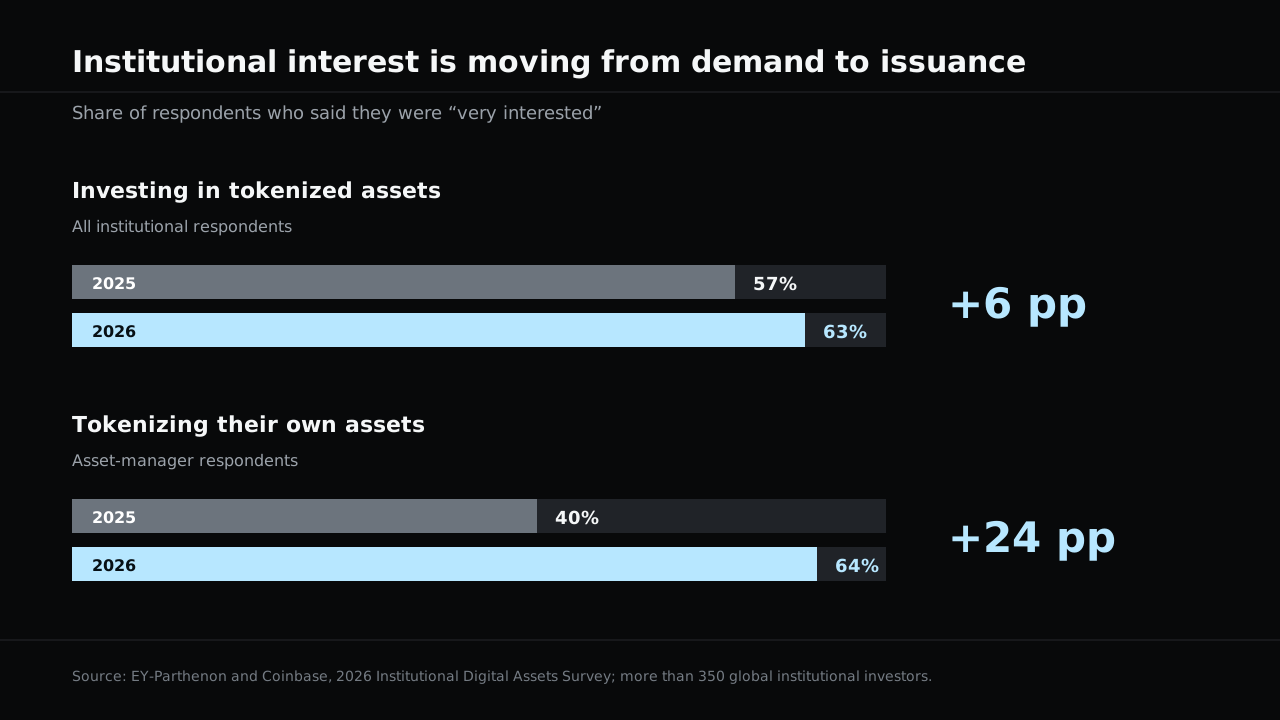
Institutional interest is already moving in that direction. The 2026 Institutional Digital Assets Survey from EY-Parthenon and Coinbase found that 63% of respondents were very interested in investing in tokenized assets, up from 57% in 2025. More strikingly, 64% of asset managers were very interested in tokenizing their own assets, up from 40% a year earlier.
The same survey found that regulatory uncertainty, integration challenges and insufficient secondary liquidity remained the leading obstacles. Those constraints are a reminder that putting an asset on-chain does not make it liquid, compliant or suitable for every portfolio. It makes the asset programmable. The quality of the rules governing that programmability becomes the next question.
The Operating Problem Starts After Issuance
Consider a future cash-management portfolio with access to tokenized money-market funds, short-duration government securities, stablecoins and on-chain lending markets. Each instrument may look cash-like, yet each carries a different combination of risks and operating conditions.
- A tokenized fund may have defined subscription windows and asynchronous redemptions.
- A stablecoin may settle continuously but introduce issuer, reserve and venue exposure.
- An on-chain lending position may offer greater liquidity at one moment and deteriorate quickly when utilization changes.
- A government-security token may be high quality as an asset but difficult to move across a particular venue or jurisdiction.
The portfolio manager’s task is therefore not simply to find the highest rate. It is to maintain a mandate while the opportunity set changes: preserve liquidity, control concentration, compare net expected returns, monitor counterparties and decide when a rebalance is worth its transaction and market-impact costs.
That is an operating problem. It is also the part of the market where AI agents are likely to be useful.
Why Agents Are Entering the Financial Stack
Tokenized markets produce machine-readable data and expose programmable actions. An agent can monitor rates, liquidity depth, price deviations, utilization, portfolio drift and protocol conditions without waiting for a periodic committee meeting. Specialized agents can separate research, portfolio construction, risk review, transaction preparation and post-trade monitoring rather than compressing every decision into one opaque model.
Ethereum’s updated guidance on AI agents now describes agents that hold wallets, pay for services and interact with smart contracts. ERC-8004 adds registries for identity, reputation and validation. Trading and payments platforms are also exposing more of their infrastructure to agent workflows.
But the ability to discover an agent, verify its identity or give it a wallet does not answer the most important institutional question: what is it allowed to do with capital?
An agent can be excellent at finding opportunities and still be the wrong place to store ultimate transaction authority.
Language models are probabilistic. Financial authorization must be deterministic at the point of execution. A model can recommend a position; it should not be able to rewrite its own concentration limit, add an unapproved counterparty or persuade the transaction layer to ignore stale prices.
From Intelligent Recommendation to Bounded Execution
The emerging control model separates intelligence from authority. In practical terms, it has five layers:
- Market intelligence. Systems normalize rates, liquidity, correlation, basis, issuer data and venue conditions.
- Portfolio intent. An agent proposes an allocation or rebalance and explains how it relates to the benchmark and risk budget.
- Deterministic policy. Independent controls test the proposal against eligible assets, approved protocols, exposure caps, price sources, slippage limits and emergency state.
- Bounded execution. Only an action that passes policy can reach an approved adapter, venue or settlement rail.
- Evidence and monitoring. The system records what was proposed, which checks passed, what executed and whether the resulting position remains inside the mandate.
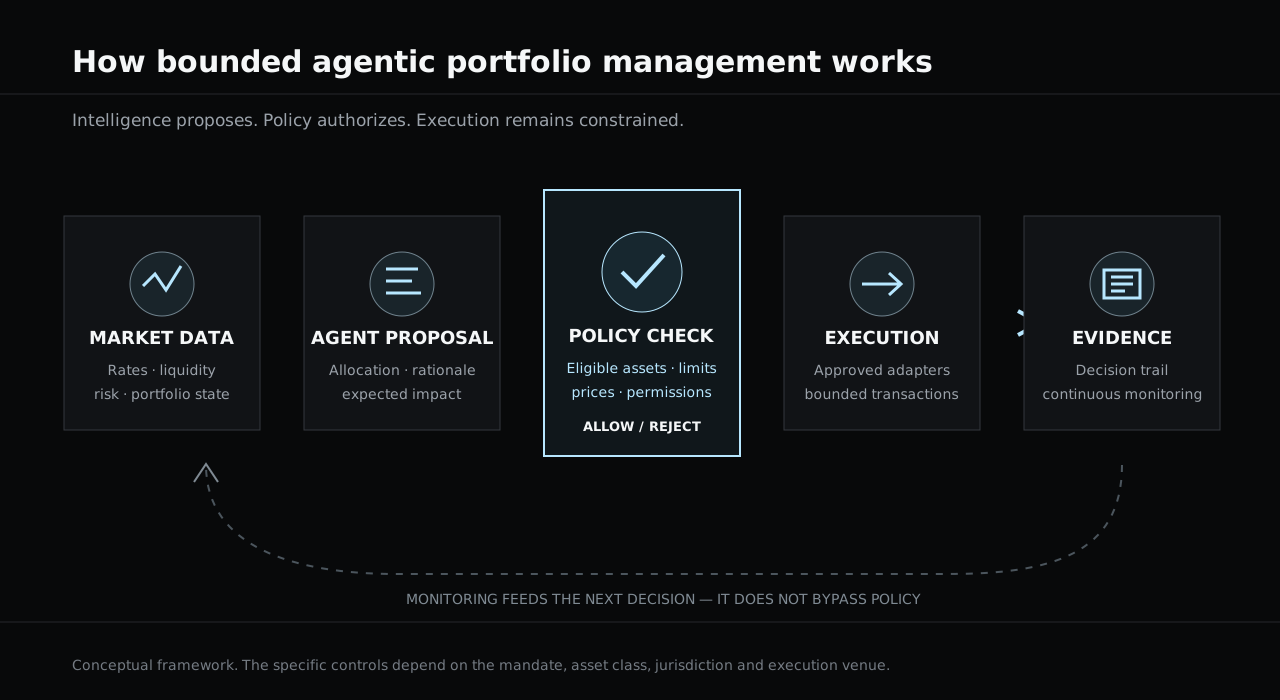
This architecture does not make investment risk disappear. Nor does an on-chain record prove that every off-chain legal or operational obligation has been met. It does make the delegation boundary clearer. Humans and governance functions define the mandate; agents perform continuous analytical work; deterministic infrastructure decides whether a proposed action is admissible.
That distinction is especially important as the asset universe expands. A rule such as “maintain dollar exposure” is too vague for autonomous execution. A usable mandate must specify eligible instruments, issuer and venue limits, minimum liquidity, pricing requirements, redemption assumptions, maximum implementation cost and the conditions under which the system must reduce risk or stop.
Where Vault Standards Fit
Tokenized vault standards provide useful building blocks for this operating layer. ERC-4626 standardizes how a single-asset vault represents deposits, withdrawals, assets and shares. That consistency makes integrations and portfolio accounting easier.
The standard is not, by itself, a complete investment policy. It does not decide which markets are eligible, how much issuer exposure is acceptable or whether a transaction is consistent with a benchmark. Newer extensions address additional operational patterns: ERC-7540 introduces asynchronous request flows relevant to assets with delayed subscriptions or redemptions, while ERC-7575 supports vault designs with multiple assets or entry points.
The direction is significant. On-chain funds are acquiring more expressive plumbing. The institutional opportunity is to combine that plumbing with explicit portfolio mandates and execution controls.
From Tokenized Products to Managed Mandates
The first phase of tokenization focused on individual products: a tokenized Treasury fund, a tokenized deposit, a tokenized credit instrument. The next phase will increasingly be about portfolios that move among these products according to a defined purpose.
Those purposes can be organised around familiar base exposures. An ETH-denominated mandate may compare staking, lending and liquid instruments without silently changing its core market exposure. A BTC-denominated mandate may prioritize secure liquidity and basis opportunities. A dollar mandate may balance tokenized cash instruments, stable settlement assets and approved sources of on-chain yield. In each case, the product is not the token alone. It is the continuously managed mandate.
This is where agentic systems can add value without pretending to replace fiduciaries, risk committees or legal infrastructure. Their advantage is coverage and speed: they can observe more variables, keep the portfolio under continuous review and prepare decisions as conditions change. Their legitimacy comes from operating within rules that remain visible, reviewable and enforceable.
What Changes Next
Three developments now appear likely to reinforce one another.
First, more tokenized funds will connect to existing distributors, custodians and post-trade systems. The most important progress may look less like a crypto launch and more like a standardized operational integration.
Second, portfolio interfaces will become more consistent. Standards for shares, requests, settlement and asset data will reduce the bespoke work required to compare and use tokenized instruments.
Third, AI agents will move from commentary toward controlled operations. The durable implementations will not be those that give a model the broadest wallet access. They will be those that make every consequential action legible as a proposal, test it against a mandate and preserve a reliable decision trail.
The Strategic Shift
Tokenization is beginning to solve distribution. It is beginning to connect digital assets to the systems that move fund orders, collateral, cash and records. That progress creates the conditions for a larger category: portfolios that can be managed continuously across traditional and on-chain instruments.
The central design question for that category is not whether AI can generate a trade. It is whether institutions can delegate useful work without delegating away control.
The answer is likely to look less like an autonomous trader with a blank cheque and more like an operating system for capital: machine intelligence for observation and decisions, deterministic policy for authority, controlled rails for execution and an audit trail that survives every handoff.
Sources and Further Reading
- DTCC: Fund/SERV Adds Ondo Finance as Its First Tokenization Member, September 16, 2026.
- FCA: Tokenisation in Wholesale Markets, September 14, 2026.
- EY-Parthenon and Coinbase: 2026 Institutional Digital Assets Survey.
- Ethereum.org: AI Agents and ERC-4626 Tokenized Vault Standard.
This article is for informational purposes only and does not constitute investment, legal or financial advice.